A field test kit for olive oil purity testing shows, at the point of purchase and before the batch is taken in, which quality grade an oil sits in and whether there is a sign that another oil has been mixed in. The reading uses a few drops of oil and a phone camera, and the result is recorded with its batch. The decision the kit supports is a commercial one: accept the batch, negotiate the price by grade, or send a sample to the laboratory. The final purity verdict and official control are given in a laboratory using the analysis methods defined by the Turkish Food Codex; the test kit does not replace them.
How is a field test kit different from home tests?
News sites rank "how to tell fake olive oil" lists that usually start with the fridge, water or paper test and end with "only a laboratory can say for sure". The second sentence is right; the first is not enough to decide anything. We cover why these methods are unreliable in our post on fake olive oil.
The question at intake is a different one. Nobody there is looking at a kitchen bottle; there is a tanker, an IBC or a batch of tins waiting at the gate, and the decision is made that day. At this point there is a need for a step between two extremes: more than a home test, faster than sending every batch to the laboratory. That step is where a field test kit belongs.
What can an olive oil test kit decide, and what can it not?
The result of an Olivex reading is a grade. It shows where the oil stands on the range from extra virgin down to low quality and adulteration. When another oil has been mixed into olive oil, the reading parts from the reference, and you see this before taking delivery of the batch.
Questions the kit answers:
- Does this batch match the declared grade, or does it sit lower?
- Does the reading part from the reference, meaning the batch should be held back before it goes into the tank?
- Are the batches from this supplier consistent across the season?
Questions the kit does not answer:
- The type and proportion of the oil mixed in. Telling seed oil, refined oil and pomace oil apart is done in the laboratory with purity parameters such as fatty acid and sterol composition, the ECN 42 difference, stigmastadienes and waxes. We explain what each parameter shows in our post on detecting other oils.
- The parameter values in a laboratory report. Free acidity, peroxide value, UV absorbance and the sensory panel result are determined in an accredited laboratory.
- An official conformity verdict. We cover this in the next section.
How does a field test relate to official analysis?
Under Article 5 of the Turkish Food Codex Communiqué on Olive Oil and Olive Pomace Oil (No. 2017/26), olive oil may not be mixed into other liquid oils, and other liquid oils may not be mixed into olive oil. Article 17 of the same Communiqué sets out the official route: samples are taken under the Regulation on Official Controls of Food and Feed, and analyses follow the Communiqué on Analysis Methods for Olive Oil and Olive Pomace Oil.
The Analysis Methods Communiqué (No. 2023/20) states its purpose plainly: to set the analysis methods for official controls of olive oil and pomace oil. The methods for official control are in its Annex 1, and the decision trees used to assess results are in Annex 2. A field test kit is not one of these methods. A reading cannot be used as an official control result or as an accredited laboratory report.
A sample a company sends to a laboratory on its own initiative has limits too. The Regulation on Food Control Laboratories calls these "special request samples": samples whose results are not a basis for inspection, sent for purposes such as quality control, verification or pre-export checks. The last page of these reports states that they may not be used for judicial and administrative proceedings or for advertising. A field reading follows the same logic: it is the company's record of its own intake decision. Official control, challenges and accreditation are covered in detail in our post on where olive oil is analysed.
How is the test run at the point of purchase?
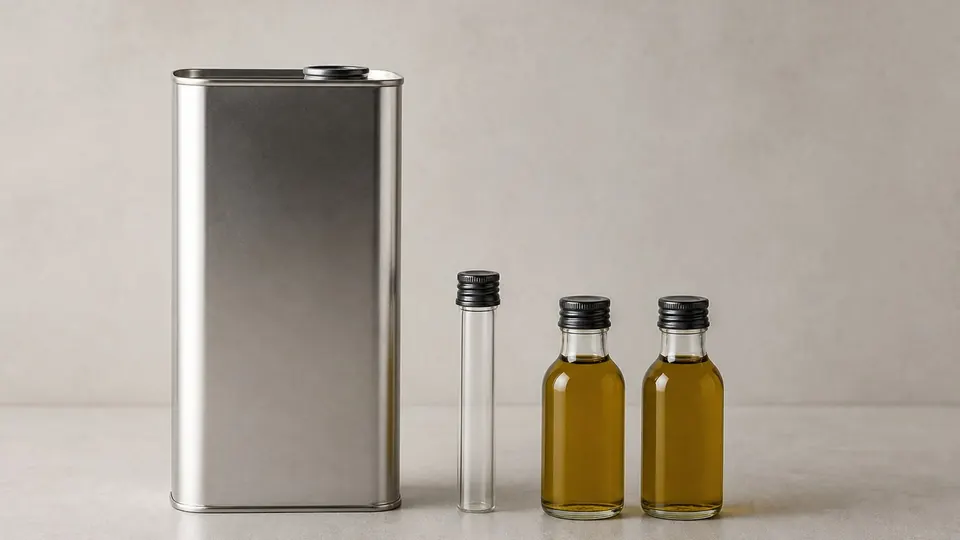
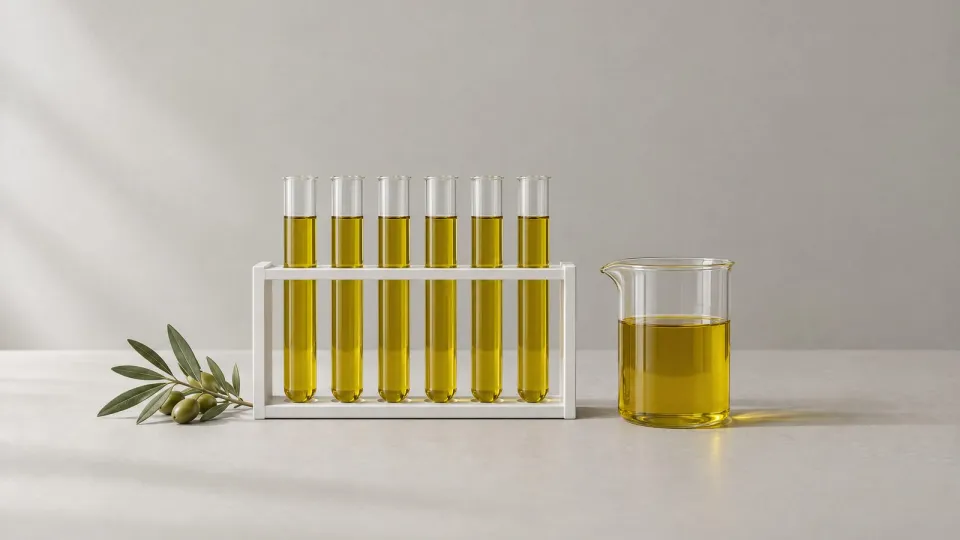
The Olivex analysis set consists of an amber 30 ml dropper bottle of pH-standard liquid, four glass droppers and a white dish. No installation and no separate instrument are needed; the reading is made with the camera of the phone your team already carries. The steps are laid out in order in the booklet in the box and in the app.
- Identify the batch. Before you start, enter the batch number and supplier in the app. Do not combine oils with different grades or numbers in a single reading.
- Take a representative sample. The reading uses a few drops and describes the oil those drops came from. A single bottle drawn from the tank tap may not describe the whole tank. Take the sample from a composite drawn at several levels and set aside a sealed reference sample from the same composite. We set out tank, IBC and tin sampling step by step in our sampling post.
- Prepare the dish. Put the set's liquid into the white dish as described in the booklet.
- Add the oil. With a glass dropper, place five drops of oil onto the liquid in the dish.
- Photograph twice. The app guides the capture and photographs the dish from above twice: first in its initial state, then after the drops have merged with the liquid.
- Tie the result to the record. The grade appears on screen and is recorded with the place, time and batch of the reading. The grade determined in a reading is not edited afterwards.
The reading is made where the oil is, within minutes, and intake keeps moving. Following the same steps every time keeps results comparable across batches and reading points.
How is the result turned into an intake decision?
The reading does not decide on its own; the rules written at the start of the season do. Applying those rules the same way to every batch moves the relationship with the supplier from bargaining power to measurement.
| Reading result | Decision at intake | Next step |
|---|---|---|
| Matches the declared grade | Accept | The reading is tied to the batch and the oil goes into the tank |
| A lower quality grade than declared | Accept, with price and tank allocation set by the measured grade | If the grade claim is disputed, laboratory analysis of quality parameters and sensory panel |
| Adulteration or departure from the reference | The batch is not taken into the tank and is held separately | Sealed sample to an accredited laboratory, requesting the purity parameters |
The middle row is the third option a measurement brings to the purchase desk: instead of refusing, renegotiating the price against the measured grade. We cover this in our purchase desk post.
In the last row the field reading shows a suspicion; it does not give the verdict. The verdict is given in the laboratory. That is why the reference sample of a suspect batch is kept sealed, and the batch number on the sample sent to the laboratory matches the number in the intake record. When the report comes back, the field reading and the report can be set side by side for the same batch.
Who is a test kit suited to?
The kit is useful wherever a decision has to be made before a laboratory result can arrive:
- Cooperatives and collection points: read the incoming batch before unloading and decide at the gate whether it goes into the tank.
- Packers: see before filling that oil from a supplier is in the expected grade.
- Exporters: read the batch before loading and choose the sample that goes to the laboratory. The analysis certificate the buyer asks for still comes from an accredited laboratory.
In every case the cost logic is the same: the laboratory is applied to the batch that carries a suspicion, not to the whole volume. You can see how collection points use it on the sector page.
Frequently asked questions
Can a test kit result be used as evidence in a dispute?
A field reading is neither an official control result nor an accredited laboratory report. In a dispute, what counts is a properly taken sample and its laboratory analysis. The reading record has value as an internal record showing which batch you accepted and on what information.
Does using the kit require laboratory experience?
No. The steps are laid out in order in the booklet in the box and in the app; anyone on your team can make a reading from the first day. The step that needs real care is taking a sample that represents the batch.
Can a bottle on a shelf also be read?
Yes. A reading can be made anywhere the bottle is opened. The reading describes the oil in that bottle; a verdict on other bottles from the same batch needs a sampling plan.
Sources
- Turkish Food Codex Communiqué on Olive Oil and Olive Pomace Oil (No. 2017/26), Official Gazette, 17 September 2017, issue 30183 (Articles 5 and 17)
- Turkish Food Codex Communiqué on Analysis Methods for Olive Oil and Olive Pomace Oil (No. 2023/20), Official Gazette, 28 October 2023, issue 32353 (Articles 1, 5 and 6)
- Regulation on Food Control Laboratories, Official Gazette, 18 February 2022, issue 31754 (Articles 4 and 25)