Fake or adulterated olive oil cannot be reliably identified by colour, smell or home methods such as freezing in the fridge, the water test or the paper test. Whether seed oil or refined oil has been mixed in is confirmed by purity analyses such as fatty acid composition, sterol profile, triglycerides (ECN 42) and stigmastadienes. The most reliable signs you can check on the shelf are the category name on the label, a price clearly below the market, and the Ministry of Agriculture and Forestry's imitation and adulteration announcements.
Which blends are prohibited in olive oil?
Under Article 5 of the Turkish Food Codex Communiqué on Olive Oil and Olive Pomace Oil, olive oil may not be mixed into other vegetable oils, and other vegetable oils may not be mixed into olive oil. The only permitted blend is riviera olive oil, made of refined olive oil and virgin olive oil and sold under that name on the label. Olive pomace oil may never be labelled as olive oil.
The forms of adulteration found in inspections are:
- Mixing cheaper seed oils such as sunflower or rapeseed into olive oil.
- Selling oil diluted with refined olive oil or olive pomace oil as extra virgin.
- Putting a higher-grade label on virgin or lower-grade oil.
- Giving refined oil, stripped of its smell and colour, the look of olive oil with a small amount of virgin oil.
The rule differs in the EU. Regulation 2022/2104 allows blends of olive oil and other vegetable oils to be sold as a "blend of vegetable oils and olive oil", with the olive oil percentage stated. In Türkiye such a blend cannot be sold under the name olive oil.
What do home tests show?
The fridge. Clouding or solidifying in the cold depends on fatty acid composition, wax content, olive variety and the holding temperature. The Communiqué accepts a range of 55 to 85 per cent for oleic acid. Pure oils whose composition can vary across such a wide range behave differently in the cold. An early-harvest oil and a late-harvest oil can behave differently in the same fridge, and both can be pure.
Water. Oil staying on top of water is true of every vegetable oil; it tells you nothing distinctive.
Paper. The shape of the stain on paper depends on the oil's fluidity and the type of paper.
Hydrochloric acid and similar chemicals. These are dangerous and say nothing about purity.
The common problem with these methods is that their results create false confidence. An oil that "passes" a test cannot be concluded to be free of adulteration.
Can you tell fake olive oil by smell and taste?
Partly. Sensory assessment is a method defined in the regulation: for the extra virgin grade, the median of defects must be zero and the median of fruitiness above zero. That assessment is carried out by a trained panel following a defined method. One person's tasting does not give the same result.
Refined oils are oils whose smell and taste have been removed. Mixed into virgin oil, they leave no obvious defect; they only weaken the fruitiness. Weak fruitiness also has innocent causes such as variety, harvest time or ageing. So tasting catches defects but often misses a low-proportion blend.
How does a laboratory detect adulteration?
Each purity criterion in Annex 1 of the Communiqué looks at a different kind of adulteration. The main ones for extra virgin and virgin are:
- Fatty acid composition: linolenic acid at most 1.0 per cent, linoleic acid between 2.5 and 21.0 per cent. Some seed oils upset this balance.
- Sterol composition: campesterol at most 4.0 per cent, delta-7-stigmastenol at most 0.5 per cent, total beta-sitosterol at least 93 per cent. The sterol profile shows the oil's botanical source.
- ECN 42 triglyceride difference: the difference between the actual and theoretical value may be at most 0.2. The Communiqué calls this parameter "detection of seed oils" outright.
- Stigmastadienes: at most 0.05 mg/kg. Its name in the Communiqué is "detection of refined vegetable oils".
- Trans fatty acids: at most 0.05 per cent for trans-oleic isomers.
- Waxes: at most 150 mg/kg; they rise when olive pomace oil is blended in.
These analyses need laboratory equipment such as chromatography. The final verdict is reached this way.
What is the Ministry's imitation and adulteration list for?
The Ministry of Agriculture and Forestry publishes foods found to be imitated or adulterated in official controls in the "Food Public Announcement" section of the Safe Food portal. Olive oil products can appear on these lists with findings such as added seed oil.
Checking the brand and batch number against these records before shopping is a concrete check a consumer can make. The list has a clear limit: it describes products that were inspected and caught on the shelf, and says nothing about a batch that has not been inspected yet.
How does Olivex answer this question?
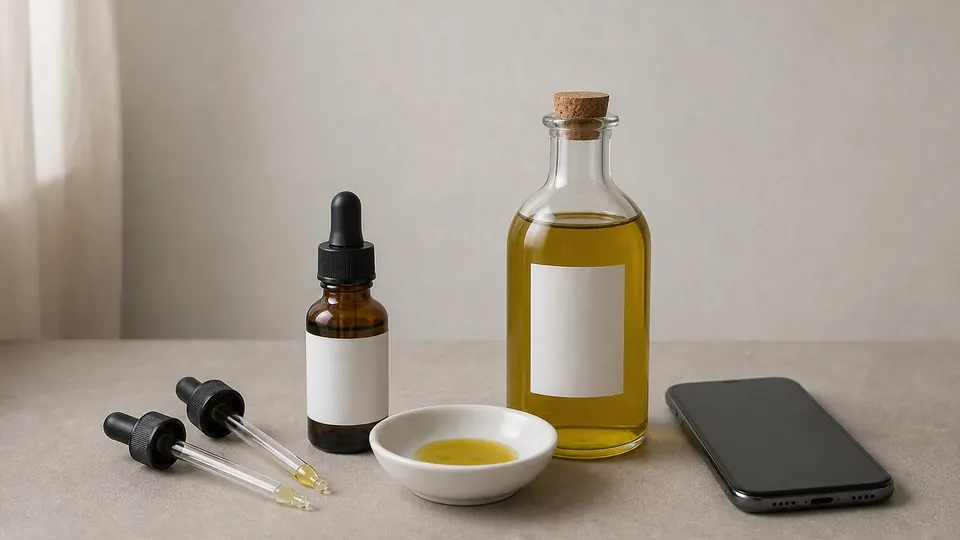
The Olivex analysis set consists of a solution, a test dish and a dropper. A few drops of oil are released into the liquid in the test dish with the set's dropper, and the mobile app photographs the state of the drops twice. The result appears on screen as a class ranging from extra virgin to low quality and adulteration, and is recorded with the batch information.
The reading can be made at home, at a collection point or at the warehouse on delivery. It does not replace the laboratory analyses above; it helps decide whether a suspect oil needs to go to a laboratory. You can see how it is used at collection points on the sector page and the application steps in how we work.
Sources
- Turkish Food Codex Communiqué on Olive Oil and Olive Pomace Oil (No. 2017/26), Official Gazette, 17 September 2017
- Annexes to No. 2023/23: current Annex 1 quality and purity criteria, Annex 2 sensory criteria
- Ministry of Agriculture and Forestry, Safe Food portal, Food Public Announcement
- International Olive Council, Trade Standard COI/T.15/NC No. 3/Rev. 22
- Commission Delegated Regulation (EU) 2022/2104 on marketing standards for olive oil