In Türkiye, olive oil is analysed in the food control laboratories of the Ministry of Agriculture and Forestry and in private food control laboratories authorised by the Ministry. In international trade, these are joined by the laboratories on the list the International Olive Council (IOC) publishes each year. Where the result will be used decides which laboratory to choose. For internal quality control and purchase decisions, a report from an accredited laboratory is enough. Official controls and objections run through laboratories designated by the Ministry. If a buyer asks for IOC recognition, the laboratory must be on that year's list for the type of analysis requested.
Where are official control samples analysed?
Under Law No. 5996, samples from official controls are analysed in Ministry laboratories or in other laboratories approved by the Ministry. The Ministry also has the power to have analyses that these laboratories cannot perform, or confirmation analyses, done in laboratories in Türkiye or abroad. The Law further provides for national reference laboratories to perform analyses related to objections and to keep methods consistent across laboratories.
The rule specific to olive oil is in the Turkish Food Codex Communiqué on Olive Oil and Olive Pomace Oil. Official samples are taken under the Regulation on Official Controls of Food and Feed (Gıda ve Yemin Resmi Kontrollerine Dair Yönetmelik), and analyses follow the Communiqué on Analysis Methods for Olive Oil and Olive Pomace Oil (No. 2023/20). That Communiqué gave bodies performing official control analyses until 1 June 2024 to comply.
The window for a business to object to an official result is short. Under the Law, the parties concerned may object to the Ministry within seven days of notification of the official control result. There is no objection to the analysis result for products with less than seven days of shelf life left, or where the reference sample is too small to be analysed. This post is not legal advice; check the current text for time limits and procedure.
When is a private food control laboratory enough?
The Regulation on Food Control Laboratories sets the framework for private laboratories. A private food control laboratory that provides analysis services to others must obtain an establishment permit and an operating permit from the Ministry. Such laboratories may not issue reports outside their approved fields of activity, and they must be accredited for the official control analyses the Ministry specifies. The Regulation defines accreditation as the assessment of a laboratory against TS EN ISO/IEC 17025 by the Turkish Accreditation Agency (TÜRKAK), with regular surveillance.
Samples that businesses submit themselves are called "özel istek numunesi" (private request samples) in the Regulation. Their results are not a basis for inspection; they are sent for purposes such as R&D, quality control, verification or checks before import or export. The last page of such reports carries the statement "Adli ve idari işlemler ile reklam amacıyla kullanılamaz" (not to be used for legal or administrative proceedings or for advertising).
In practice this means:
- Purchase decisions, supplier checks, pre-export checks: a private request analysis is made for exactly these purposes and is enough.
- Official controls and objections: what counts is the sample taken by the Ministry and its analysis. Your own report does not replace the official result in that process. It still shows which batch you accepted and on what result.
Why check accreditation parameter by parameter?
Accreditation is granted for specific tests and methods, not for a laboratory as a whole. A laboratory may be accredited for acidity and peroxide value but not for sterol composition or sensory analysis. The parameters needed for a grade decision on olive oil are:
- Quality parameters: free acidity, peroxide value, UV absorbance (K232, K270, Delta K) and, for extra virgin, fatty acid ethyl esters.
- Sensory assessment: the medians of defects and fruitiness set by a trained panel using the official method.
- Purity parameters: fatty acid and sterol composition, the ECN 42 difference, stigmastadienes and waxes.
Sensory assessment needs its own setup. So ask separately whether the laboratory doing the chemical analyses has a sensory panel and whether that panel is within its accreditation scope. When choosing a laboratory, look at the accreditation scope published by TÜRKAK and confirm that every parameter you need is listed there. How the parameters are read on a report is covered in how do you read an olive oil analysis report.
What does IOC recognition mean?
The IOC recognises physico-chemical laboratories and sensory panels separately. The list of recognised laboratories is published every year. It applies to the period from 1 December to 30 November and is made public after approval by IOC Members at their November session. At the time of writing, the current lists are document T.21/Doc. No 13/Rev. 28 for physico-chemical laboratories and T.28/Doc. No 3/Rev. 28 for sensory analysis laboratories.
The rules described on the IOC's page can be summarised as follows:
- Prerequisite: to apply, a laboratory must hold ISO 17025 accreditation from its national accreditation body. It must also pass the proficiency tests run by the IOC.
- Two types: physico-chemical laboratories fall into two groups. Type A laboratories perform advanced analyses such as ethyl esters, fatty acids and phenolic compounds. Type B laboratories focus on residues and contaminants.
- Who may apply: public and private laboratories issuing reports to third parties, and laboratories of olive oil companies analysing their own oils.
- Sensory panels: they take part in a proficiency test twice a year with five samples. Only sensory laboratories carrying out the official control of virgin olive oils may apply, and applications go through the country's competent authority.
- Limits on use: recognition may only be cited for the period and type of testing for which it was granted.
When a buyer asks for an "IOC-approved laboratory", two things need checking. The laboratory must be on the list for the period covering the report date, and it must be recognised for the type of analysis requested. Because the lists are renewed every year, relying on last year's list is not enough.
Where is analysis done for export?
Export raises two separate questions: the inspection Turkish regulation requires, and the documents the buyer asks for in the contract.
The Ministry of Trade's Communiqué on Commercial Quality Inspection in the Export and Import of Certain Agricultural Products (No. 2026/21) entered into force on 1 January 2026. Its Annex 1 lists olive oil with the standard TS 341 Yemeklik Zeytinyağı (edible olive oil); the entry covers edible olive oil and excludes crude olive oil. Under the Communiqué:
- Samples taken during inspection are sealed jointly by the trade inspector and the company.
- Samples are analysed in Ministry laboratories or in authorised laboratories. At the company's choice, the analysis may also be done in a laboratory accredited by TÜRKAK under TS EN ISO/IEC 17025; in that case the laboratory undertaking form and the analysis documents are uploaded to TAREKS, the Ministry's online inspection system. Where more than one analysis is made, the Ministry laboratories are taken as the reference.
- Samples are kept for at most sixty days, or until a dispute between buyer and seller is settled.
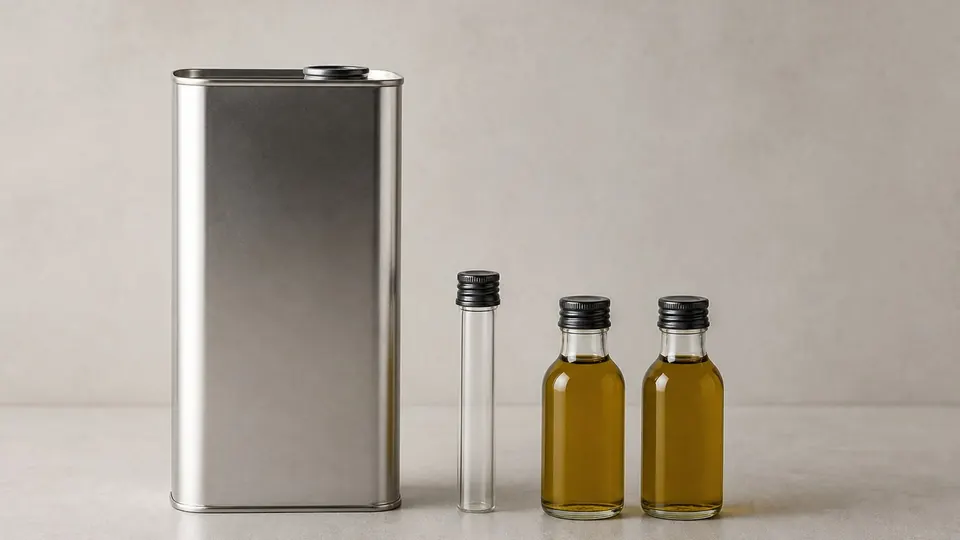
- For tanks and similar large containers, samples are taken at equal intervals from at least three levels, starting from the top, and combined. From this composite, three sets of one-litre samples are prepared and sealed: two sets go to the laboratory as the analysis and reference samples, and one stays at the inspection unit as a reference sample.
Because the Communiqué can change, check the current text and its Annex 1 entry before applying.
On the buyer's side, the contract decides. It should state which standard the grade will be assigned under (the Turkish Food Codex, the IOC trade standard or EU Regulation 2022/2104) and in which kind of laboratory the analysis will be done. In EU official conformity checks, sensory assessment is carried out by panels approved by the Member State on its territory.
What should you do before sending a sample to the laboratory?
A laboratory result is only as sound as the sample sent:
- Take a representative sample. The IOC standard refers to ISO 5555 for sampling. A bottle filled from the tank tap alone may not represent the whole tank; this is why export inspection takes tank samples from several levels.
- Protect the sample from light and heat. EU Implementing Regulation 2022/2105 requires samples to be put in a dark place away from heat as quickly as possible. They should be sent to the laboratory no later than the fifth working day, or otherwise kept so that they do not degrade.
- Set aside a reference sample. As the Regulation defines it, a reference sample (şahit numune) is taken from the same batch together with the sample and stored under suitable conditions for objections and disputes. A sealed, labelled reference sample for each batch makes a repeat analysis possible in any later dispute.
- State which parameters you need. An analysis that asks only for acidity does not give a grade decision. A grade claim needs all quality parameters and the sensory assessment; a suspected blend needs the purity parameters.
- Tie the sample to the batch record. The batch number on the sample label should match the one in the intake record and on the report.
Where does a field reading fit in this flow?
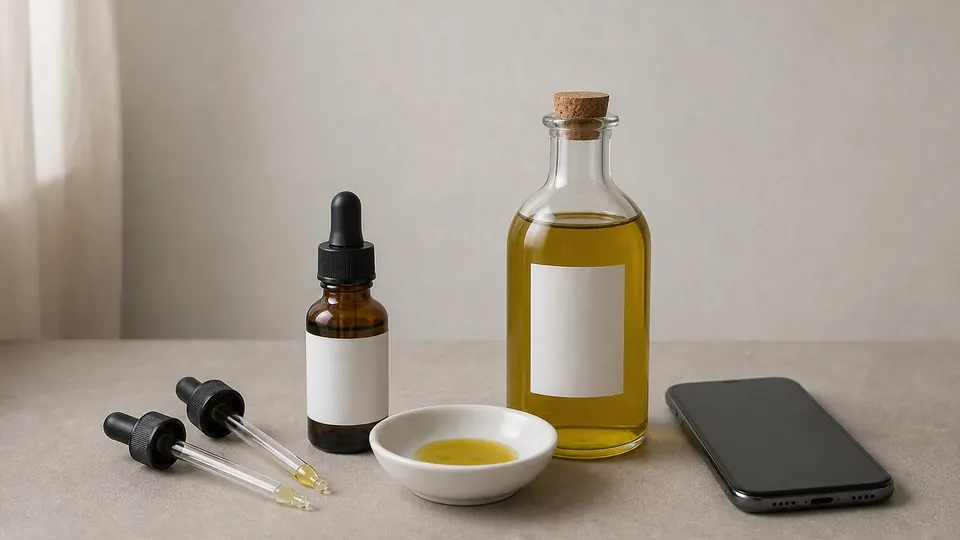
At harvest, sending every batch that reaches a collection point to the laboratory is not practical. This is where Olivex is used. A few drops of oil go into the analysis set's test dish, the mobile app makes the reading, and where the oil sits on the range from extra virgin to low quality and adulteration is recorded with the batch. The reading does not replace laboratory analysis. It is there to decide, while the oil is still in front of you, which batches need to go to an accredited laboratory. You can read about its use at intake on the collection points page and its role in export on the exporters page.
Frequently asked questions
Can a report from an accredited private laboratory be used in an official dispute?
The report on a sample a business submits itself carries the statement that it may not be used for legal or administrative proceedings or for advertising. In an official control, the sample taken by the Ministry and its analysis are what count. Your own report is valuable as a record of what your purchase decision rested on.
Can a laboratory without IOC recognition analyse olive oil?
Yes. IOC recognition is not a legal permit; it is a recognition programme based on IOC proficiency testing. In Türkiye, what a private laboratory needs is an establishment and operating permit from the Ministry and accreditation for the relevant analyses. IOC recognition usually comes up when a buyer asks for it in the contract.
Is sensory analysis done in every laboratory?
No. Sensory assessment needs a trained panel and a setup that follows the official method. Ask separately whether the laboratory doing the chemical analyses has a panel and whether the panel is within its accreditation scope.
How do I know whether the IOC list is current?
The list is published each year for the period from 1 December to 30 November, and the document number includes the revision and date. The date of your report should fall within the period of the list the laboratory appears on.
Sources
- Law No. 5996 on Veterinary Services, Plant Health, Food and Feed (Articles 31 and 33), in Turkish
- Regulation on Food Control Laboratories, Official Gazette, 18 February 2022, in Turkish
- Regulation amending the Regulation on Food Control Laboratories, Official Gazette, 1 August 2024 (Article 5), in Turkish
- Turkish Food Codex Communiqué on Olive Oil and Olive Pomace Oil (No. 2017/26), Official Gazette, 17 September 2017, in Turkish
- Turkish Food Codex Communiqué on Analysis Methods for Olive Oil and Olive Pomace Oil (No. 2023/20), Official Gazette, 28 October 2023, in Turkish
- Communiqué on Commercial Quality Inspection in the Export and Import of Certain Agricultural Products (No. 2026/21), Official Gazette, 31 December 2025, 4th repeat issue (Articles 13, 14, 33 and Annex 1), in Turkish
- International Olive Council, Standardisation and Research Unit: Recognition of Laboratories and Panels
- International Olive Council, list of recognised physico-chemical laboratories, T.21/Doc. No 13/Rev. 28
- International Olive Council, Trade Standard COI/T.15/NC No. 3/Rev. 22
- Commission Implementing Regulation (EU) 2022/2105 on conformity checks and methods of analysis (Articles 8 and 10)