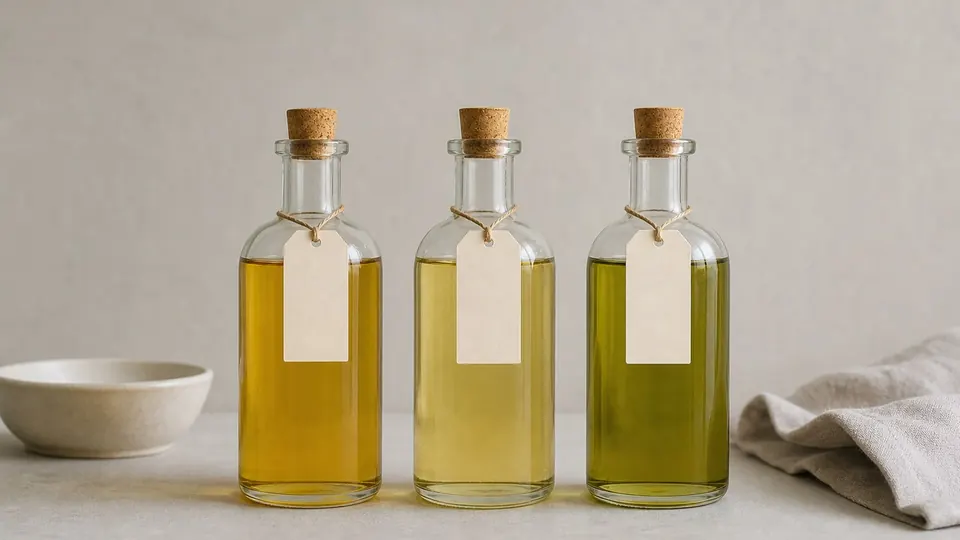
Under the Turkish Food Codex Communiqué on Olive Oil and Olive Pomace Oil, extra virgin olive oil (naturel sızma) may have a free acidity of no more than 0.8 grams per 100 grams expressed as oleic acid (0.8%), and virgin olive oil (naturel birinci) no more than 2.0 grams (2.0%). A virgin oil above 2.0% counts as "crude olive oil" and falls outside the grades sold for direct consumption. Acidity alone does not set the grade, though: peroxide value, ultraviolet absorbance and sensory assessment must all sit within their limits at the same time.
What does acidity measure in olive oil?
Acidity is the amount of free fatty acids in the oil. Oil in the olive is normally held as triglycerides. When the fruit is bruised, spoils on the tree or in the crate, waits too long between harvest and milling, or the oil is stored badly, that structure breaks down and free fatty acids appear.
Acidity therefore indicates how carefully the raw material was handled and processed. Oil from sound, fresh fruit that was milled quickly has low acidity.
A common confusion: free acidity has nothing to do with a sour taste on the tongue. The pungency felt in the throat and the bitterness on the tongue come from other compounds and are defined as positive attributes in the Communiqué's sensory annex. Acidity cannot be estimated by tasting; it can only be measured in a laboratory.
What should acidity be for each grade?
The free acidity limits in Annex 1 of the Communiqué are:
- Extra virgin olive oil: no more than 0.8%
- Virgin olive oil: no more than 2.0%
- Crude olive oil: above 2.0%
- Refined olive oil: no more than 0.3%
- Riviera olive oil (a blend of refined and virgin oil): no more than 1.0%
- Olive pomace oil: no more than 1.0%
The International Olive Council (IOC) trade standard and EU Regulation 2022/2104 also use 0.80% for extra virgin and 2.0% for virgin. The difference is that the IOC standard has a separate grade, "ordinary virgin olive oil", with acidity up to 3.3%; the Turkish Food Codex has no such grade. An exporter should therefore agree at the outset which standard the buyer is using when asking about grade.
Does low acidity prove an oil is extra virgin?
No. The extra virgin grade also requires these quality criteria alongside acidity:
- Peroxide value: no more than 20 meq active oxygen/kg
- K232 (UV absorbance at 232 nm): no more than 2.50
- K270 (UV absorbance at 270 nm): no more than 0.22
- Delta K: no more than 0.01
- Fatty acid ethyl esters (FAEE): no more than 35 mg/kg
- Sensory: median of defects zero, median of fruitiness above zero
For virgin olive oil the peroxide limit is the same; K232 is capped at 2.60, K270 at 0.25, and the median of defects may go up to 3.5. If any one of these criteria fails, the oil cannot stay in the higher grade, however low its acidity.
Acidity can mislead on purity as well. Refined olive oil already has acidity below 0.3%, so a product blended with refined olive oil or another refined vegetable oil can show low acidity. The Communiqué looks for refined oil blends through separate parameters such as stigmastadienes (no more than 0.05 mg/kg for extra virgin) and UV absorbance.
How should you read the acidity on a label?
The acidity printed on a label usually reflects a measurement taken before filling. The oil keeps changing in the bottle; light, heat and oxygen lower its quality over time.
EU Regulation 2022/2104 sets a telling rule here: if maximum acidity is stated on the label, it must be the value expected by the minimum durability date, and peroxide value, wax content and UV absorbance must be shown alongside it, in the same field of vision and the same font size. So a bare "acidity 0.3%" on a label is not an adequate statement on the EU market. The main declaration on the label is the category name; we explain what the category names mean in how to read an olive oil label.
How is acidity measured?
The official measurement is done in a laboratory. The oil is dissolved in a defined solvent mixture and titrated with a base of known concentration; free fatty acids are calculated as oleic acid from the amount of base used. The IOC standard refers to its own method document for this. A grade decision can be made once peroxide value, UV absorbance and a sensory panel have been assessed on the same sample as acidity.
A laboratory result is definitive but takes time. At harvest, sending every batch that reaches a collection point to the laboratory is not practical, and the decision is usually made on tasting and declaration.
Where does Olivex fit in this step?
The Olivex result is a class: at the point of purchase it shows where the oil sits on the range from extra virgin to low quality and adulteration. The reading is made with the analysis set: a few drops of oil go into the liquid in the test dish, the mobile app photographs the drops twice, and the result is recorded with the batch information.
Accredited laboratory measurement of acidity, peroxide value and UV absorbance stays where it is. Olivex's job is to decide, while the batch is still being received, which batches need to go to those measurements. You can read how the method works on the technology page and how it is applied in the field in how we work.
Sources
- Turkish Food Codex Communiqué on Olive Oil and Olive Pomace Oil (No. 2017/26), Official Gazette, 17 September 2017
- Communiqué amending No. 2017/26 (No. 2023/23), Official Gazette, 8 April 2023
- Annexes to No. 2023/23: Annex 1 olive oil characteristics and Annex 2 sensory criteria
- International Olive Council, Trade Standard Applying to Olive Oils and Olive Pomace Oils, COI/T.15/NC No. 3/Rev. 22
- Commission Delegated Regulation (EU) 2022/2104 on marketing standards for olive oil